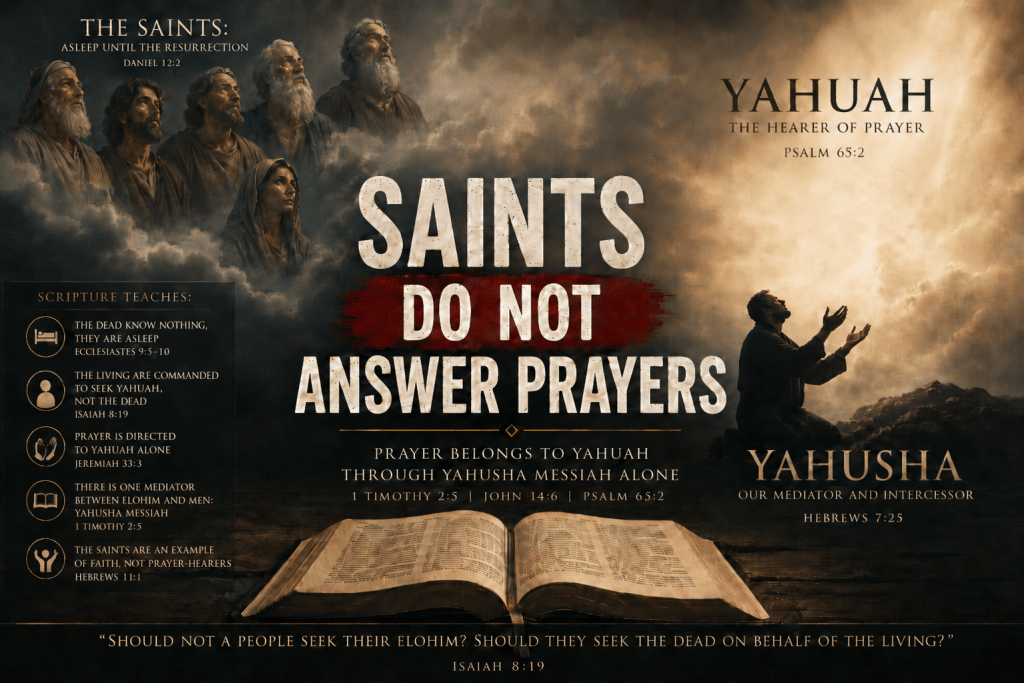
Why Scripture Directs Us to YAHUAH Alone Through Yahusha Messiah
Many people have been taught that it is acceptable to pray to “saints” who have died, asking them to intercede, help, protect, guide, or answer requests. The practice is often defended by saying, “We ask living believers to pray for us, so why not ask the saints in heaven?”
But when we test this belief by Scripture, the pattern is clear: prayer is directed to YAHUAH, through Yahusha Messiah, who alone is the Mediator and living Intercessor for His people. The Scriptures never command us to pray to dead saints, never show the righteous praying to dead saints, and repeatedly warn against seeking the dead.
The set-apart ones who died in faith should be honoured as examples of faithfulness, but they are not to be treated as heavenly mediators or prayer-hearers. Scripture gives that place to YAHUAH alone, through His Son, Yahusha Messiah.
1. The Dead Do Not Know, Work, or Answer
One of the strongest reasons Scripture gives against praying to dead saints is that the dead are not described as active hearers of earthly prayer.
Ecclesiastes says:
“For the living know that they shall die, but the dead know not any matter…”
Ecclesiastes 9:5
It continues by saying that their love, hatred, and envy have already perished, and that they no longer have a portion in what is done under the sun. Then it says:
“All that your hand finds to do, do it with your might; for there is no work or planning or knowledge or wisdom in She’ol where you are going.”
Ecclesiastes 9:10
This is a major problem for the idea of praying to saints. If the dead know nothing, if there is no work, planning, knowledge, or wisdom in She’ol, then Scripture does not present them as beings who hear millions of prayers, process requests, and respond from heaven.
Psalm 146 also says:
“Do not put your trust in princes, In a son of man, in whom is no deliverance. His spirit goes out, he returns to his earth; In that day his plans perish.”
Psalm 146:3-4
When a man dies, his plans perish. Scripture does not say that after death he becomes a heavenly prayer-handler. It says his breath departs, he returns to the earth, and his plans perish.
Job also says:
“His sons come to esteem, and he does not know it; And they are brought low, and he does not perceive it.”
Job 14:21
This is very clear. The dead do not even know the earthly condition of their own sons. If they do not know whether their own children are honoured or brought low, how can they be hearing the prayers of strangers across the earth?
The Psalms add the same thought:
“For in death there is no remembrance of You; In She’ol who gives You thanks?”
Psalm 6:5
And again:
“The dead do not praise Yah, Nor any going down to silence.”
Psalm 115:17
Death is described as silence, not as an active ministry of hearing and answering prayer.
2. Death Is Described as Sleep Until the Resurrection
Scripture often describes the death of the righteous as “sleep.” This matters because many people speak as if departed saints are fully active, watching over the living and receiving requests. But Scripture places the hope of the dead in the resurrection.
Daniel says:
“And many of those who sleep in the dust of the earth wake up, some to everlasting life, and some to reproaches, everlasting abhorrence.”
Daniel 12:2
Those who have died are described as sleeping in the dust until they awake. Their hope is resurrection, not becoming prayer-answering mediators.
Yahusha used the same language concerning Lazarus:
“Our friend El‘azar has fallen asleep, but I am going there, to wake him up.”
John 11:11
When the disciples misunderstood, Yahusha spoke plainly:
“El‘azar has died.”
John 11:14
So Yahusha Himself used sleep as a way to describe death.
The same language appears in the writings of the emissaries. Stephen, after being stoned, “fell asleep” in Acts 7:60. Paul says that some believers had “fallen asleep” in 1 Corinthians 15:6. He also says:
“And if Messiah has not been raised, then also those who have fallen asleep in Messiah have perished.”
1 Corinthians 15:18
Paul’s hope was not that the dead saints were already functioning as intercessors. His hope was the resurrection.
He continues:
“But now Messiah has been raised from the dead, and has become the first-fruit of those having fallen asleep.”
1 Corinthians 15:20
And:
“Each in his own order: Messiah the first-fruits, then those who are of Messiah at His coming.”
1 Corinthians 15:23
The dead in Messiah are raised at His coming. That is the promise.
1 Thessalonians says the same:
“The dead in Messiah shall rise first.”
1 Thessalonians 4:16
The consistent teaching is that the dead in Messiah sleep until the resurrection. Scripture does not teach that they are now to be prayed to.
3. YAHUAH Alone Is the Hearer of Prayer
Scripture gives a beautiful and direct title to YAHUAH:
“O You who hears prayer, To You all flesh comes.”
Psalm 65:2
YAHUAH is the Hearer of prayer. Prayer belongs to Him.
Throughout Scripture, the people of Elohim are told to call upon YAHUAH, not departed saints.
“Call upon Me in the day of distress — Let Me rescue you, and you esteem Me.”
Psalm 50:15
“Call unto Me, and I shall answer you, and show you great and inaccessible matters, which you have not known.”
Jeremiah 33:3
“And it shall be that everyone who calls on the Name of YAHUAH shall be delivered.”
Joel 2:32
These passages are direct. Call upon YAHUAH. He hears. He answers. He delivers.
When Yahusha taught His taught ones how to pray, He did not say, “Pray to the saints,” or “Ask the righteous dead to intercede.” He said:
“This, then, is the way you should pray: Our Father who is in the shamayim…”
Matthew 6:9
Again in Luke:
“When you pray, say: Our Father in the shamayim…”
Luke 11:2
Yahusha directed prayer to the Father.
Later, Yahusha taught that requests should be made in His Name:
“And whatever you ask in My Name, that I shall do, in order that the Father might be esteemed in the Son.”
John 14:13
And:
“Whatever you ask the Father in My Name He shall give you.”
John 16:23
This is the pattern: prayer to the Father, in the Name of Yahusha. There is no instruction to pray to Miriam, Peter, Paul, the prophets, martyrs, or any other departed set-apart one.
4. Yahusha Alone Is the Mediator
One of the clearest passages in all Scripture is:
“For there is one Elohim, and one Mediator between Elohim and men, the Man Messiah Yahusha.”
1 Timothy 2:5
There is one Mediator between Elohim and men. Not many mediators. Not dead saints. Not heavenly patrons. Not departed believers. Yahusha alone holds that office.
Hebrews says:
“Therefore He is also able to save completely those who draw near to Elohim through Him, ever living to make intercession for them.”
Hebrews 7:25
Yahusha is the One who ever lives to intercede. That phrase is powerful. The living Intercessor is not a dead saint. It is the risen Messiah.
Romans says:
“Messiah… who is at the right hand of Elohim, who also makes intercession for us.”
Romans 8:34
1 John says:
“And if anyone sins, we have an Intercessor with the Father, Yahusha Messiah, a righteous One.”
1 John 2:1
Hebrews also says:
“For Messiah has not entered into a Set-apart Place made by hand… but into the shamayim itself, now to appear in the presence of Elohim on our behalf.”
Hebrews 9:24
Yahusha appears before YAHUAH on our behalf. He is the Advocate. He is the Intercessor. He is the Mediator. He is the way to the Father.
Yahusha Himself said:
“I am the Way, and the Truth, and the Life. No one comes to the Father except through Me.”
John 14:6
That leaves no room for a system where believers must approach YAHUAH through dead saints. The access is through Yahusha.
5. Seeking the Dead Is Forbidden
Scripture does not merely stay silent about praying to the dead. It warns against seeking the dead.
Deuteronomy says:
“Let no one be found among you… who calls up the dead.”
Deuteronomy 18:10-11
And it says such practices are an abomination to YAHUAH.
Leviticus says:
“Do not turn to mediums, and do not seek after spiritists to be defiled by them. I am YAHUAH your Elohim.”
Leviticus 19:31
Again:
“And the being who turns to mediums, and to spiritists, to go whoring after them, I shall set My face against that being…”
Leviticus 20:6
Isaiah gives one of the clearest rebukes:
“And when they say to you, ‘Seek those who are mediums and wizards, who whisper and mutter,’ should not a people seek their Elohim? Should they seek the dead on behalf of the living?”
Isaiah 8:19
That question cuts directly into this issue:
Should the living seek the dead?
Scripture’s answer is no. The people of YAHUAH should seek their Elohim.
Someone may say, “But praying to saints is not the same as necromancy.” But the basic issue remains: a living person is addressing the dead, seeking help, favour, or intercession. Scripture never gives permission for that. Instead, it asks: should the living seek the dead?
The tragic example of King Sha’ul confirms this. Sha’ul sought guidance through a medium, calling for Samuel after Samuel had died. This was not presented as righteousness. Scripture says:
“Thus Sha’ul died for his trespass which he had committed against YAHUAH… and also for asking a medium for guidance.”
1 Chronicles 10:13
He did not seek YAHUAH properly, and this became part of his downfall.
6. The Saints Are Servants, Not Objects of Prayer
The set-apart ones are servants of YAHUAH. They are examples of faith. But they are not to be prayed to, worshipped, or treated as divine helpers.
When Cornelius bowed before Peter, Peter did not accept it.
“But Kĕpha raised him up, saying, ‘Stand up, I myself am also a man.’”
Acts 10:26
Peter was an apostle. He was chosen by Yahusha. Yet he refused this honour and reminded Cornelius that he was only a man.
In Acts 14, when people tried to honour Paul and Barnabas as gods, they tore their garments and cried out:
“Men, why are you doing this? We also are men with the same nature as you…”
Acts 14:15
Even heavenly messengers refuse worship. In Revelation, when John fell before a messenger, the messenger said:
“See, do not! I am your fellow servant… Worship Elohim!”
Revelation 19:10
Again in Revelation 22:
“See, do not! For I am your fellow servant… Worship Elohim.”
Revelation 22:9
If apostles and heavenly messengers reject misplaced honour, how much more should believers reject prayerful devotion toward departed saints?
Yahusha said:
“You shall worship YAHUAH your Elohim, and Him alone you shall serve.”
Matthew 4:10
Prayer is an act of trust, dependence, and spiritual appeal. It belongs to YAHUAH.
7. Living Believers May Pray for One Another
One common defence of praying to saints is this: “We ask other believers to pray for us. Asking saints to pray is the same thing.”
But Scripture shows a clear distinction. Believers are told to pray for one another while alive. There is no command, example, or teaching that believers should ask the dead for prayer.
James says:
“Pray for one another, so that you are healed. The earnest prayer of a righteous one accomplishes much.”
James 5:16
Paul repeatedly asks living believers to pray for him:
“Praying at all times… for all the set-apart ones; also for me…”
Ephesians 6:18-19
“Continue in prayer… praying also for us…”
Colossians 4:2-3
“Brothers, pray for us.”
1 Thessalonians 5:25
“For the rest, brothers, pray for us…”
2 Thessalonians 3:1
This is the biblical pattern: living believers pray for one another.
But nowhere do we see Paul asking Isaiah, Mosheh, Eliyahu, Stephen, or any dead righteous person for intercession. Nowhere do the apostles instruct believers to pray to departed saints. Nowhere are the assemblies told to seek help from dead believers.
The difference is simple:
Asking a living brother to pray is fellowship within the Body.
Asking the dead for help is seeking those whom Scripture says are asleep and silent until the resurrection.
8. The Hope of the Saints Is Resurrection, Not Receiving Prayers
The righteous dead are not forgotten by YAHUAH. They are precious to Him. But their hope is resurrection.
Yahusha said:
“The hour is coming in which all those in the graves shall hear His voice, and shall come forth…”
John 5:28-29
Paul said:
“There shall be a resurrection of the dead, both of the righteous and the unrighteous.”
Acts 24:15
Hebrews says:
“It is appointed for men to die once, and after this the judgment.”
Hebrews 9:27
Revelation says:
“And I saw the dead, small and great, standing before the throne…”
Revelation 20:12
The dead await resurrection and judgment. Scripture does not present them as a heavenly class of prayer-answerers.
Even Paul looked forward to receiving his crown in that Day:
“For the rest, there is laid up for me the crown of righteousness, which the Master, the righteous Judge, shall give to me on that Day…”
2 Timothy 4:8
Paul did not speak as though he would die and immediately become a mediator for others. His hope was the Day of reward, the appearing of Yahusha, and the resurrection.
9. Honour the Saints, But Do Not Pray to Them
It is right to honour the faithful. Hebrews 11 gives a long record of righteous men and women who lived by belief. Their lives are examples to us. We can learn from Abraham, Sarah, Mosheh, Rahab, Dawid, the prophets, the emissaries, and the martyrs.
But honour is not prayer.
Remembering their faith is not the same as asking them for help.
Learning from their example is not the same as calling upon them.
Scripture says we are surrounded by witnesses in the sense that their lives testify to belief, endurance, and obedience. But Scripture never says they are listening to our prayers or answering our requests.
The difference must be guarded carefully.
The saints point us to YAHUAH.
They do not replace YAHUAH.
They trusted in Yahusha.
They do not become mediators beside Yahusha.
10. The Biblical Pattern Is Clear
When we put the Scriptures together, the conclusion is simple.
The dead do not know what happens under the sun.
The dead are described as asleep.
The dead do not praise YAHUAH from the grave.
YAHUAH alone is the Hearer of prayer.
Yahusha alone is the Mediator.
Yahusha alone lives to intercede.
The living are commanded to pray for one another.
Seeking the dead is forbidden.
No prophet, apostle, or righteous believer ever teaches prayer to dead saints.
Therefore, the practice of praying to saints cannot be built from Scripture.
It must be added from tradition.
And if tradition teaches what Scripture does not command, we must choose Scripture.
Yahusha rebuked those who elevated tradition above the command of Elohim:
“Thus you have nullified the command of Elohim by your tradition.”
Matthew 15:6
And:
“In vain do they worship Me, teaching as teachings the commands of men.”
Matthew 15:9
Our worship and prayer must be shaped by the Word, not by human tradition.
Conclusion: Saints Do Not Answer Prayers
The set-apart ones who died in faith are not our enemies. They are not to be mocked or dishonoured. They are examples of endurance, belief, and obedience. But they are not prayer-hearers. They are not mediators. They are not intercessors between us and YAHUAH.
Scripture gives that role to Yahusha Messiah alone.
There is one Elohim.
There is one Mediator.
There is one living Intercessor.
There is one Way to the Father.
That Way is Yahusha.
So when we are distressed, we do not call upon the dead.
When we need mercy, we do not seek departed saints.
When we need help, we do not pray to men.
When we need forgiveness, deliverance, wisdom, healing, or strength, we go directly to YAHUAH through Yahusha Messiah.
For YAHUAH is the Hearer of prayer.
And Yahusha lives forever to intercede for those who draw near to Elohim through Him.
Saints do not answer prayers. YAHUAH does.

 Brother In Messiah
Leave a comment